Welcome to a deep dive into the fascinating world of force definition. Whether you’re a student, educator, or just curious about physics, understanding force is essential to grasping how the universe works. Let’s explore its meaning, types, applications, and more in a way that’s both engaging and accurate.
What Is the Force Definition in Physics?
The term force definition refers to any interaction that, when unopposed, changes the motion of an object. In physics, force is a vector quantity, meaning it has both magnitude and direction. It is measured in newtons (N), named after Sir Isaac Newton, who laid the foundation for classical mechanics.
The Scientific Meaning of Force
According to the Encyclopedia Britannica, force is defined as an influence that can cause an object with mass to change its velocity. This includes starting to move from rest, stopping, speeding up, slowing down, or changing direction.
- Force causes acceleration.
- It can deform objects (e.g., stretching a spring).
- Forces always occur in pairs (Newton’s Third Law).
Force as a Vector Quantity
Unlike scalar quantities like temperature or mass, force has direction. For example, pushing a box to the right applies a force in the positive x-direction, while pulling it left applies a negative x-direction force. This directional nature is crucial in solving physics problems involving multiple forces.
“Force is not just a push or pull; it’s a precise physical quantity that governs motion.” — Dr. James Kakalios, physicist and author of ‘The Physics of Superheroes’.
Force Definition and Newton’s Laws of Motion
No discussion of force definition is complete without Newton’s three laws of motion. These laws form the cornerstone of classical mechanics and explain how forces affect objects.
Newton’s First Law: The Law of Inertia
Also known as the law of inertia, this states that an object at rest stays at rest, and an object in motion stays in motion with the same speed and in the same direction unless acted upon by an unbalanced force.
- Explains why seatbelts are necessary.
- Demonstrates that force is needed to change motion.
- Inertia depends on mass: more mass = more resistance to change.
Newton’s Second Law: F = ma
This is the mathematical heart of the force definition. The law states that the acceleration of an object is directly proportional to the net force acting on it and inversely proportional to its mass. The formula is:
F = m × a
Where:
- F = net force (in newtons)
- m = mass (in kilograms)
- a = acceleration (in m/s²)
For example, if a 10 kg object accelerates at 2 m/s², the net force is 20 N.
Newton’s Third Law: Action and Reaction
For every action, there is an equal and opposite reaction. This means forces always come in pairs. When you jump, your legs apply a force to the ground, and the ground applies an equal force back, propelling you upward.
- Explains rocket propulsion.
- Clarifies why you feel recoil when firing a gun.
- Shows that forces are mutual interactions.
Types of Forces in the Force Definition Framework
Understanding the force definition involves recognizing the different types of forces that exist in nature. These can be broadly categorized into contact and non-contact forces.
Contact Forces
These are forces that occur when two objects are physically touching.
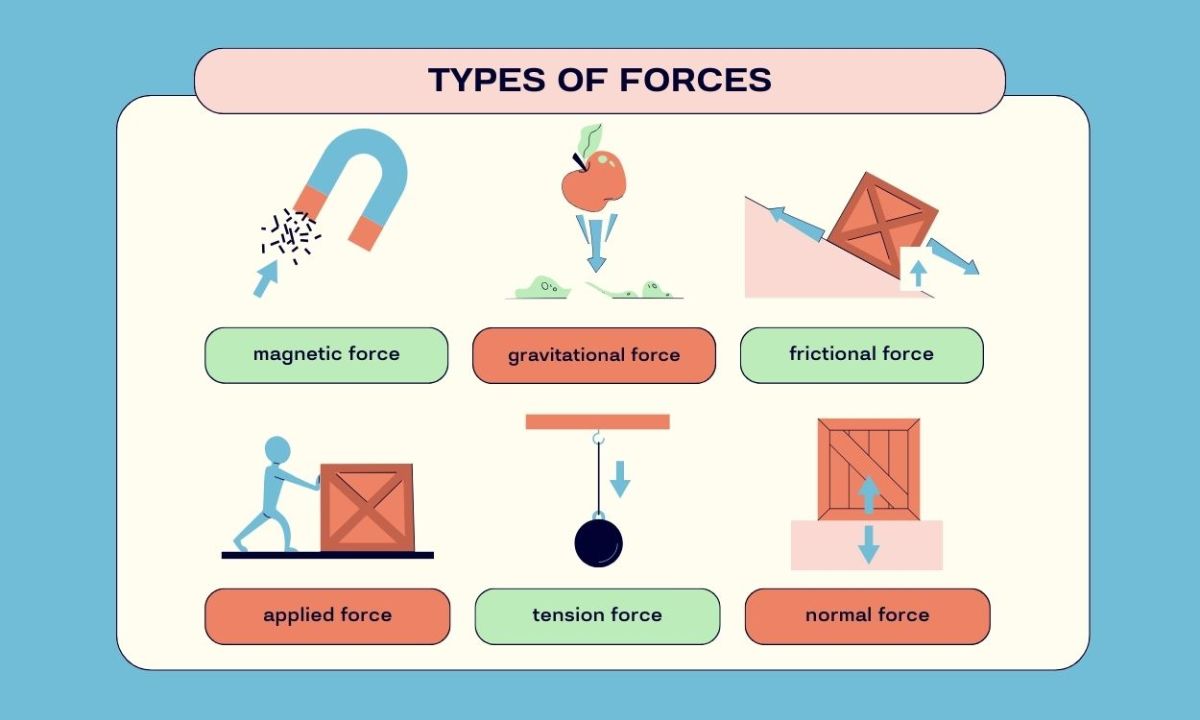
- Frictional Force: Opposes motion between surfaces. Without it, walking or driving would be impossible.
- Normal Force: The support force exerted by a surface. When you stand on the floor, the floor pushes up with a force equal to your weight.
- Tension Force: Transmitted through a string, rope, or cable when it is pulled tight.
- Applied Force: A force applied by a person or object directly.
Non-Contact or Field Forces
These forces act over a distance without physical contact.
- Gravitational Force: The attraction between masses. Earth’s gravity pulls objects toward its center. Learn more at NASA’s Space Place.
- Electromagnetic Force: Includes electric and magnetic forces. Responsible for chemical bonds and light.
- Nuclear Forces: The strong and weak forces that hold atomic nuclei together.
Everyday Examples of Force Definition in Action
The force definition isn’t just theoretical—it’s all around us. From walking to driving, forces are at play in every movement.
Walking and Friction
When you walk, your foot pushes backward against the ground. Friction provides the forward force that propels you. Without friction (like on ice), you’d slip.
- Static friction prevents slipping.
- Kinetic friction slows motion.
- Shoe treads increase friction for better grip.
Driving a Car
A car engine generates force through combustion, turning wheels. The tires push backward on the road, and the road pushes forward on the tires (Newton’s Third Law).
- Brakes apply friction to slow the car.
- Air resistance opposes motion at high speeds.
- Centripetal force keeps the car on curved roads.
Gravity and Falling Objects
When you drop a ball, gravity accelerates it downward at 9.8 m/s². The force of gravity (weight) is F = m × g, where g is the acceleration due to gravity.
“We are constantly under the influence of forces, even when we’re standing still.” — Dr. Michio Kaku
Measuring Force: Tools and Units
To apply the force definition practically, we need ways to measure force accurately.
The Newton: Standard Unit of Force
One newton (N) is the force required to accelerate a 1 kg mass at 1 m/s². It’s a derived SI unit: 1 N = 1 kg·m/s².
- 1 N ≈ weight of a small apple.
- Human bite force can exceed 700 N.
- Car engines produce thousands of newtons of force.
Tools for Measuring Force
Several instruments are used to measure force in labs and industries.
- Spring Scale: Uses Hooke’s Law (F = kx) to measure force based on spring extension.
- Force Sensor: Electronic device that converts force into an electrical signal.
- Load Cell: Used in industrial scales and weighing systems.
Force Definition in Engineering and Technology
Engineers rely on the force definition to design safe and efficient structures and machines.
Structural Engineering and Load Forces
Buildings must withstand various forces: gravity (dead load), people and furniture (live load), wind, and earthquakes. Engineers calculate stress and strain to ensure safety.
- Skyscrapers use steel frames to resist compressive and tensile forces.
- Earthquake-resistant designs use dampers to absorb seismic forces.
- Bridges are designed to distribute forces evenly across supports.
Mechanical Systems and Force Transmission
Machines like levers, pulleys, and gears manipulate force to make work easier. They trade force for distance or vice versa, based on the principle of mechanical advantage.
- A lever amplifies input force using a fulcrum.
- Pulleys reduce the effort needed to lift heavy objects.
- Gears transfer rotational force efficiently.
Advanced Concepts in Force Definition
Beyond basic physics, the force definition extends into advanced fields like relativity and quantum mechanics.
Force in Einstein’s Theory of Relativity
In general relativity, gravity is not a force but a curvature of spacetime caused by mass. Objects follow geodesics (straight paths in curved space), which appear as curved trajectories.
- Explains Mercury’s orbit anomaly.
- Predicts gravitational lensing.
- Replaces Newtonian gravity at cosmic scales.
Quantum Forces and the Standard Model
In quantum field theory, forces are mediated by particles called gauge bosons.
- Photon mediates electromagnetic force.
- W and Z bosons mediate weak nuclear force.
- Gluons mediate strong nuclear force.
The search for a unified theory continues, aiming to merge all fundamental forces into one framework.
Common Misconceptions About Force Definition
Despite its fundamental nature, the force definition is often misunderstood.
Force vs. Energy: A Critical Distinction
Many confuse force with energy. Force is a push or pull, while energy is the capacity to do work. Force can transfer energy, but they are not the same.
- Pushing a wall applies force but does no work (no displacement).
- Energy is measured in joules; force in newtons.
- Work = Force × Distance.
Objects in Motion Don’t Need Constant Force
A common myth is that moving objects require constant force. In reality, once moving, an object continues at constant velocity in space unless a force acts (Newton’s First Law).
- In space, spacecraft coast without engine thrust.
- On Earth, friction slows objects, requiring continuous force to maintain speed.
- Force changes motion, not maintains it.
Mass vs. Weight: A Force-Related Confusion
Mass is the amount of matter (kg); weight is the gravitational force on that mass (N). Your mass is the same on Earth and the Moon, but your weight differs.
“Mass is how much stuff you’re made of. Weight is how hard gravity pulls on that stuff.” — Bill Nye
What is the basic force definition in physics?
The basic force definition in physics is any interaction that changes the motion of an object. It is a vector quantity measured in newtons (N) and described by Newton’s laws of motion.
What are the four fundamental forces in nature?
The four fundamental forces are gravitational, electromagnetic, strong nuclear, and weak nuclear forces. These govern all interactions in the universe, from atoms to galaxies.
How is force measured?
Force is measured using tools like spring scales, force sensors, and load cells. The standard unit is the newton (N), defined as the force needed to accelerate 1 kg at 1 m/s².
Is force a scalar or vector quantity?
Force is a vector quantity because it has both magnitude and direction. This is essential for accurately predicting motion in physics problems.
Can force exist without contact?
Yes, non-contact forces like gravity and magnetism act over distances without physical touch. These are also called field forces.
Understanding the force definition is crucial for mastering physics and appreciating the mechanics of the world around us. From Newton’s laws to modern quantum theories, force remains a central concept. Whether in daily life or advanced science, recognizing how forces shape motion and structure deepens our connection to the physical universe. By exploring its types, measurements, and applications, we gain not just knowledge—but power over nature’s rules.
Further Reading:
